
When one thinks about the costs to start a business in Italy, the entrepreneur immediately gets chills. Actually the word COSTS gives goose bumps anywhere in the world, but paying in euros? Is it viable?
In this text you will have a good idea of how much bureaucracy costs to start a business in Italy, but also valuable guidance on other costs and expenses.
At the end of this article you have tips on how much money you will need to get your business up and running.
What are the costs to start a business in Italy?
In order to talk about the costs to start a business in Italy, we must first reflect on the most important thing in a business.
Rather than talking about the Italian bureaucracy, which exists and is complex, it is not the most important, although many here often complain about it.
Above all, as with any business, anywhere, the most important thing is the market. In this way, before opening your Partita IVA (VAT number in Italy) it is vital to test the market with your product and/or service.
After all, who will buy from you? Have you sold it to anyone before? Do you know who you’re going to deal with? Do you understand this market?
Obviously, I am not talking about having 100% of the answers, but you need to have an idea of what you will face.
In my opinion this market test should be done before officially opening the company. Test with your acquaintances, family, neighbors, and then broaden your sampling of people until you have a good idea how to present and sell your product or service.
Certainly one of the differences between being a business owner or being an adventurer is how much you know about your market.
A very common case is people coming to Italy to sell something to its compatriots. For instance, a Brazilian entrepreneur trying to sell to Brazilians who are already in Italy. It can be very interesting, but some questions must be answered:
- What does this Brazilian community buy here in Italy?
- Do Brazilians still need the same products and services they used to buy in Brazil or have they replaced with something in Italy?
In the same way you may wonder if Italians would buy what you have to offer.
Anyway, here is this short introduction to market knowledge as it has a direct bearing on costs. We’ll look back at the market issue in more detail in a future article.
A good plan
Continuing the search for the costs of starting a business in Italy, the first thing is to make a plan.
You can write a business plan or even a simple plan, the important thing is to have a good idea about at least who will work with you (employees and partners), how will be the share between partners, who will finance your business , if you can get financing, where your business is, and a sales forecast.
The more information you put on paper, the easier the next step is, which is to talk to an commercialista (accountant in Italy) so that he can budget how much the fees for starting the business and its own fees will cost.
If you want to know more about business plan, I recommend this article: Business plan: How it can prevent your startup from failing.

The commercialista
The amount you pay the commercialista depends a lot on the information you give him. Furthermore, each company will have its own profile and thus each commercialista customer will have specific fees. Finally, It all depends on your activity, size, employees and revenue.
For information only, on average the commercialista‘s fees are € 1,200 a year. This varies widely but serves as a reference. Usually the form of payment is made on advances. For example, 3 installments of € 400.00 every 4 months. With this amount the commercialista will pay the small fees and its own fees.
If the advance is terminated, the trader will render an account and ask for an additional amount, otherwise the account will be made at the end of the year and he will show the remaining credit for the following year.
How to choose the right commercialista
The most commonly used criterion, almost obvious, is the value of fees, but I recommend that it is not the only criterion. It is important to have a commercialista as close as possible, preferably in the same city, as you will need advice at one time or another.
Also knowing if the commercialista works with companies in the same industry as yours can help a lot. Try to get references about the commercialista to see if he will be a partner or some kind of unreachable “God of Olympus” and difficult to talk to.
Of course, you can just choose the cheapest commercialista, but be aware that in this case it will usually just be a taxpayer and fill out government forms without much help in your business. The choice is always yours.
In my case, I did interviews with 3 offices and considered the values, empathy with the commercialista and internet structure and the office itself.
The notaio
Another important value in the costs of opening the company may be the registration in the notaio (notary in Italy). Some business activities do not have to go through this opening registration, but if necessary there will be a fee of € 1,000 to € 1,500. For example, a store with two partners usually has to register with the notary. The commercialista will advise on this.
Contributions and fees
In several cases, such as commerce, the company’s partners must contribute to the INPS (National Health and Security System), with at least € 900.00 every 3 months. If any partner works in another company, even for a few hours, this contribution decreases. When the company makes a higher profit, this contribution may increase.
Other fees are for the type of business you have like background music (if any), garbage disposal and more. These are generally lower rates and are paid annually, but I would recommend putting some € 200 to get started. Again, it will depend on your activity.
For those who will work with commerce there is also the registration in Camera de Commercio, which will be about € 150.00 per year.
Anyway, the bank rates, which in general are not high. You can initially operate with a private, simpler banking account with lower rates or even no fees.
Taxes
On taxes, here is the VAT (Value Added Tax), with that typically system of credit on purchase and debit on sale, with an accountability every 3 months. The standard rate is 22%, with a reduction to 10% or 4% depending on the product or service.
Individual companies (ditte individuale) and partnerships (società di persone) pay a 23% to 43% rate of income depending on the range of values. The capital company (società di capitale) pays a rate of 24% on the income. There are, however, special arrangements for small businesses with lower rates, such as 5%.
These are the most important taxes. There may be others with much less impact on revenues that affect a particular category.
Licenses and certificates
Another factor is whether or not licenses or certificates are required. For example, those who deal with packaged foods should take a course called HACCP that costs little, about € 40.00 for 4 hours.
On the other hand, those who handle food must take a longer course and cost around € 100.00 to € 150.00.
In a number of cases one can also hire the service of a certified professional and thus fulfill the requirement without having to take the course.
Each industry has its own requirements, something that also happens in other countries.
Time required to registry a business
Regarding the time required to have your company registered and allowed to open, it usually takes from 3 to 6 months, depending on whether or not it must be registered with the notaio.
In any case the commercialista will be able to inform you after reviewing your business plan.
After all, how much money do I need?
A calculation must be made considering all the costs to start a business in Italy (registered), and all the costs for the first year. Separately considered all the expected revenues by deducting the taxes on these revenues. Finally, subtract the costs number from the revenues number and you will know how much money will be necessary in the first year.
This is the minimum starting capital you will need to pay for the expenses and costs of starting a business in Italy.
A little confused? The following explains further.
Initial investment
- Are you renting or using your own apartment/house?
- Do you need a warehouse to store goods?
- Will there be a store to sell to the public?
- Contracting of services such as internet, bank, electricity and others.
- Hiring employees and third parties.
- Purchase of vehicles, machinery and equipment.
- Acquisition of furniture and materials.
- Initial inventory.
- Investment in marketing, website, e-commerce and social networks.
Costs of registry and licenses to open the business
Add the costs to start a business in Italy that we saw earlier.
Monthly and annual costs
- Employees: twice the amount the person receives. Example: Someone who washes dishes in a restaurant receives monthly between € 800.00 to € 1000.00 for 8 hours a day and will cost between € 1.600.00 to € 2000.00 to its employer.
- Electricity, water, gas, Internet, telephone and other bills. They can be monthly, bimonthly or quarterly.
- Bank charges.
- Maintenance of building, machinery, vehicles and equipment.
- Annual fees such as garbage collection and Camera di Commercio.
Revenues
About revenues estimation, my suggestion is to be more realistic than optimistic, because in the early months it is common for companies to fail to generate profit.
To calculate how much money you need to pay for expenses and costs to start a business in Italy and for the first year:
- Add the costs to start a business in Italy with the initial investment and one year of monthly costs and expenses you pay even if you sell nothing or little.
- On the other hand, add up the total sales forecast for the first year and discount the VAT tax.
- If money is left, which doesn’t always happen in the first year, great. Just discount the income tax and there will be a surplus.
- If money is lacking, which is likely, this is the amount you will need to have to start the business and keep it in the first year of life.
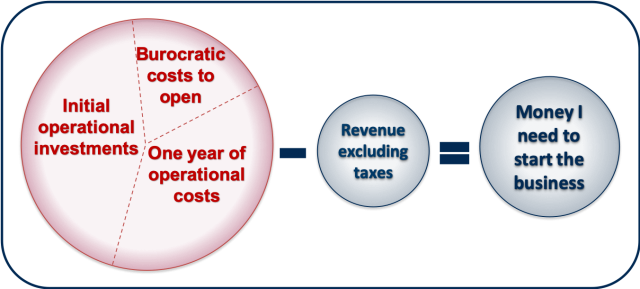
The result is a minimum amount needed to your company be able to breathe in the first year, as long as the forecast sales take place, but beware of over-optimism.
Warning: This is a simplified calculation. You need to consider when you will need to pay for purchases and when you will receive for sales. For example, if you pay everything first and take too long to receive sales, you may be short of money on this wait. If this wait is normal for your business, then you will need extra money to keep cash at the cashier. It’s all about strategy.
Optimism or Realism
The key is to balance the optimism and energy of an entrepreneur profile with the realism of a financial profile.
If the entrepreneur be too optimism, may be mistaken and the profit may not happen, making the financial situation complicated.
On the other hand, if the financial realism is exaggerated, increasing the costs forecast to start a company in Italy, the entrepreneur may be discouraged even before starting.
To achieve this balance, nothing better than making a plan and showing someone who can help you see the situation from an outside point of view. But be careful, just show who can really help you.
Get to work. Start by outlining your plan, search for the missing information, and build the structure of your business.
This will give you more clarity on what needs to be adjusted.
Greetings and see you in a next article.
And now?
Did this article help you? Is something missing? Would you like to suggest a subject for a future article? Please leave a comment.
Come meet us and discover our techniques to improve you and your business. It’s very easy. Just contact us:
Do you want to receive our newsletter? Sign up now: